Navigating the regulatory landscape can be daunting for medical device manufacturers striving to bring innovative products to market. Fortunately, the FDA has established the Safer Technologies Program (STeP), designed to expedite the development and review of medical devices. The program’s goal is to bring safer technologies to patients in need as quickly and safely as possible.
What is the STeP Program?
The Safer Technologies Program (STeP) is an FDA program started in 2021 which aims to reduce the burden of regulatory submission for qualifying medical devices. STeP designations are only given to technologies that treat non-life-threatening conditions, in contrast to those eligible for the Breakthrough Devices Program. Additionally, STeP technologies must be significantly safer than the current standard of care. Different types of submissions are included in the program, including Q-Submissions, IDEs, 510(k)s, De Novo requests, PMAs, and certain PMA supplements.
What are the benefits of the STeP Program?
A STeP designation can increase access to FDA personnel, alter timing and design of clinical trials, and change required manufacturing data, all of which support shorter submission timelines.
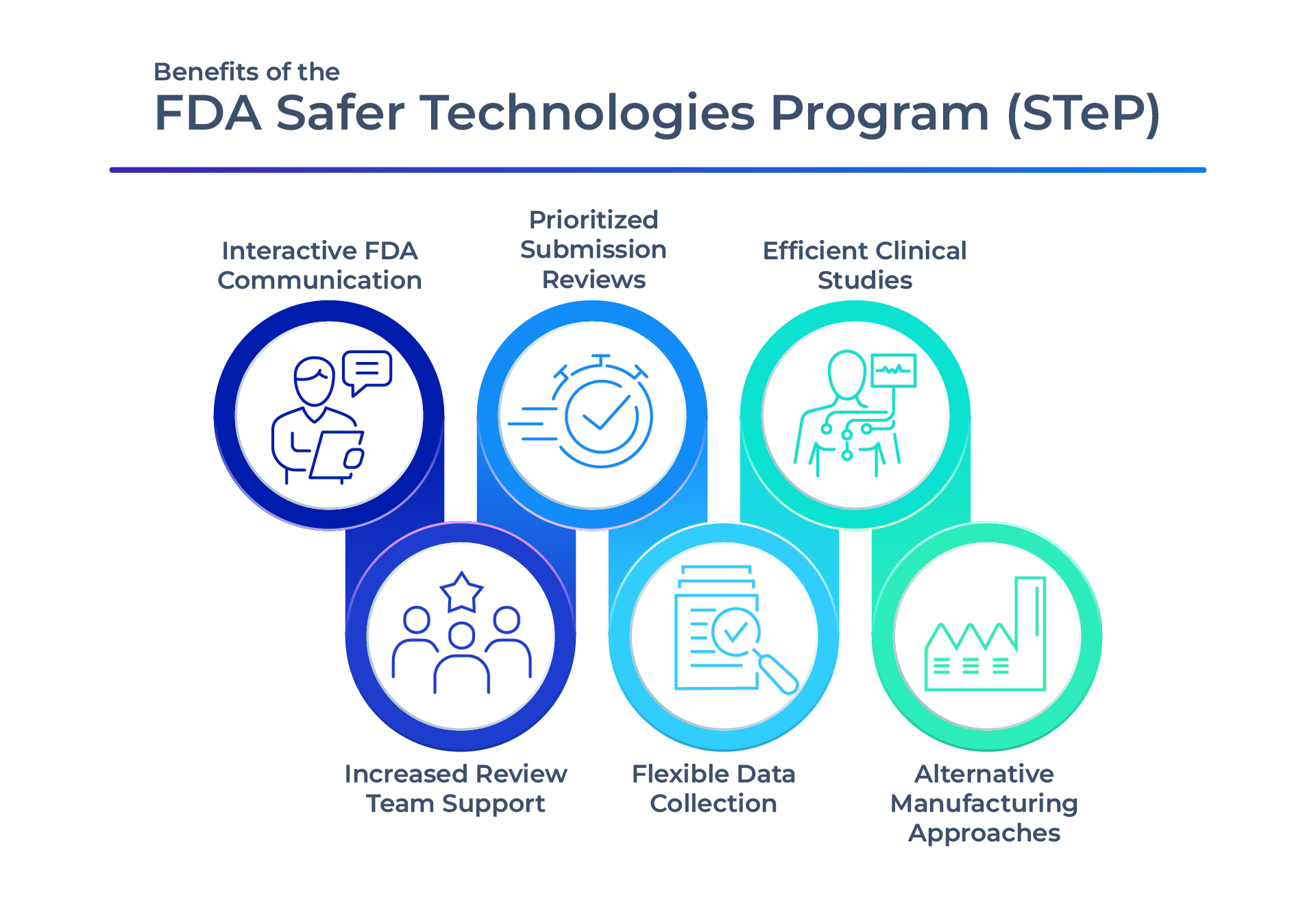
Interactive and timely communication with the FDA
Sponsors of a STeP device and the FDA agree on a communication plan which includes overall goals and expectations about response times. The FDA recommends the use of “tracked changes” and redlined versions of documents and summary tables or other documentation that clearly track points of agreement, disagreement, and unresolved issues from previous FDA interactions.
Increased review team and senior management support
The FDA provides a higher level of review team support and increased senior management engagement. While review teams are trained on STeP requirements, including a senior manager can further expedite discussions by ensuring adherence to programmatic principles and efficiency.
Prioritized review of regulatory submissions
The FDA prioritizes STeP devices by increasing review resources, not only upon submission, but also earlier in the device lifecycle.
Flexibility in benefit-risk assessments and data collection
When appropriate, the FDA may allow certain evidence, including clinical data, to be collected postmarket with appropriate commitments or controls. FDA intends to use timely postmarket data collection to facilitate expedited and efficient development and review.
Efficient and flexible clinical study designs
FDA intends to consider proposals for efficient and flexible clinical study protocols, including those incorporating real-world data sources, that may be used to support the proposed indication and/or labeling.
Alternative manufacturing approaches for PMA submissions
The FDA may accept less quality and manufacturing information, as long as statutory and regulatory requirements are still satisfied using an alternative approach. It will also strive for an expedited review of manufacturing and quality system compliance.
How does the FDA communicate with STeP companies?
The FDA suggests using one of several mechanisms of communication to provide structure during discussions. A company must pick one or more of the following methods and request to use it via Q-submission.
Data Development Plan (DDP):
A Data Development Plan (DDP) is a high-level document intended to help ensure expectations for the entire product lifecycle are in alignment. DDP discussions can be one of the first submissions after a STeP designation has been granted.
Sprint discussion:
Sprint discussions involve a set timeframe in which the company and FDA agree to work toward a specified goal. Meeting frequency within the sprint can vary and is complemented by document exchange.
Regular status updates:
Regular status updates include informal communication (email, meetings, etc.) to discuss timeframe for a planned marketing submission, next steps or plans for future discussions.
Which medical devices qualify for the STeP program?
A device must be expected to significantly improve the benefit-risk profile of a treatment or diagnostic procedure to qualify for the STeP program. A device does not need to meet every STeP criterion. It must, however, demonstrate a meaningful safety improvement through at least one of the criteria below.
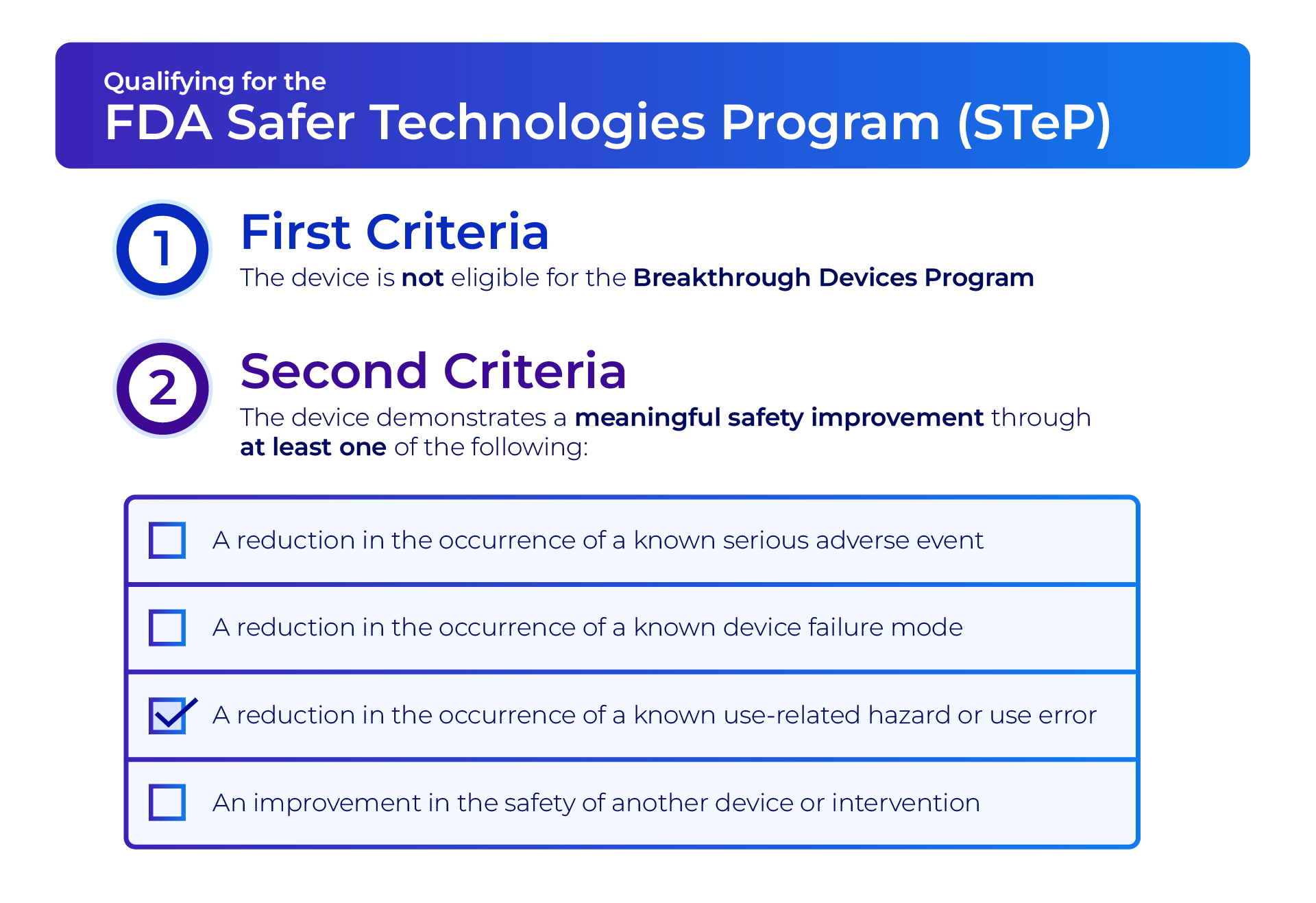
- a reduction in the occurrence of a known serious adverse event,
- a reduction in the occurrence of a known device failure mode,
- a reduction in the occurrence of a known use-related hazard or use error, or
- an improvement in the safety of another device or intervention.
Additionally, a device must not be eligible for the Breakthrough Devices Program.
What are some examples and details explaining the STeP criteria?
Reduction in the occurrence of a known serious adverse event
For STeP inclusion, the FDA considers whether a device is expected to reduce the occurrence of a known serious adverse event associated with a treatment, diagnostic procedure, or existing medical device.
Examples include:
- Modifications to existing devices that significantly reduce serious infections.
- New implantable devices that reduce debilitating symptoms post-implantation.
- New in-vitro diagnostic devices that reduce serious adverse events linked to a newly approved drug affecting current diagnostic devices.
Reduction in the occurrence of a known device failure mode
For this requirement, the FDA will evaluate if the medical device is expected to reduce the occurrence of a known failure mode that could lead to serious adverse health consequences, such as death, life-threatening situations, or permanent injuries. Devices must address actual, not hypothetical, failure modes.
Reduction in the occurrence of a known use-related hazard or use error
For STeP inclusion, the FDA will consider devices with significant safety innovations that reduce use-related hazards or errors due to device design or operation, rather than issues arising from labeling or instructions.
Improvement in the safety of another device or intervention
This benefit might come from the device acting as an accessory or as a standalone device that reduces risks associated with treatments or procedures. Examples include:
- a device enabling a single intervention for a pediatric illness instead of multiple surgeries
- an innovation replacing invasive procedures with non-invasive methods
Does your medical device qualify for STeP?
If you still have questions after reading this blog, our regulatory team can review your device and give specific recommendations. It’s in the interest of our partner companies to pursue the Safer Technologies Program. And, ultimately, it is in the interest of patients, who benefit from a safer and more effective healthcare landscape.
References
Safer Technologies Program for Medical Devices Guidance for Industry and Food and Drug Administration Staff, January 6, 2021.